


Gildan 5000 was once the go-to choice for the Print on Demand seller community thanks to its low base cost, stable supply, and ability to scale large volumes. During a time when the market was less demanding, many sellers achieved rapid growth simply by testing designs, running ads, and optimizing pricing on this blank. However, as we move into 2026, the U.S. POD market has changed significantly.
This raises an important question: Is Gildan 5000 still suitable for scaling POD in 2026, or should it now be used only for specific purposes? The article below analyzes Gildan 5000 from the perspective of today’s POD market, helping sellers clearly understand its advantages, limitations, and how to build a smarter blank selection strategy to optimize profit and reduce risk when scaling.
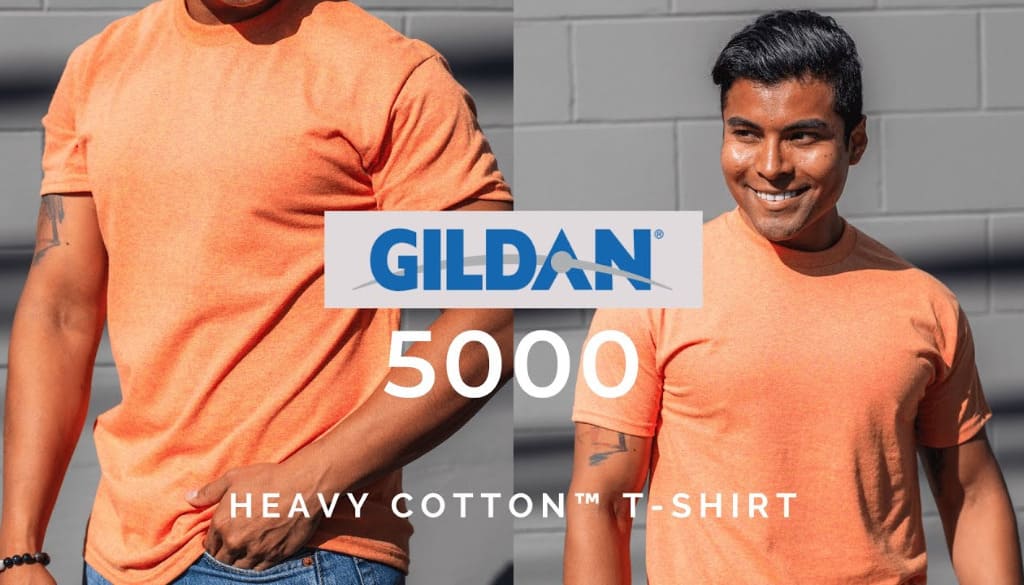
Overview of Gildan 5000: The “Legend” of the Entry-Level Segment in the POD Industry
Gildan 5000 (Unisex Heavy Cotton T-Shirt) has long established itself as a “go-to” blank in commercial printing and Print on Demand. With an optimal balance between cost and functionality, it has become a top choice for high-volume scaling campaigns.
Key Brand Characteristics of Gildan 5000
- Fabric & fit: The shirt is made from 100% cotton with a heavyweight fabric, resulting in a distinctive boxy fit. The stiffer fabric helps the garment hold its shape well and prevents it from clinging to the body, making it suitable for a wide range of body types (unisex).
- Cost efficiency (base cost): One of Gildan 5000’s greatest strengths is its low price point. This allows sellers to optimize profit margins and easily implement competitive pricing strategies across eCommerce platforms.
- Print compatibility: The stable fabric surface works well with common printing technologies such as DTF (Direct to Film) and basic DTG (Direct to Garment), ensuring clear and consistent print quality.
The Role of Gildan 5000 in a POD Business Strategy
During the rapid growth phase of the POD market, Gildan 5000 was considered the safest option. Thanks to its low price point, sellers could freely test a large number of designs with minimal financial risk. Once a “winner” was identified, scaling to high volumes became straightforward due to its abundant and stable supply.
The POD Market in 2026: When Quality Becomes the New “Rule of the Game” for Scaling
To determine whether entry-level blanks like Gildan 5000 can still serve as effective scaling tools, sellers must confront the dramatic shift in the POD market in 2026. The era of “good designs alone can sell” has officially come to an end, making way for a competitive landscape driven by real, tangible value.
Changes in Customer Behavior
Customers in key markets such as the U.S. and the EU have become more discerning and demanding in 2026. An eye-catching design is no longer enough to maintain loyalty. They now expect:
- Real-life experience: Fabric softness and overall comfort during movement.
- Product durability: The ability to retain shape and color after multiple washes.
- Authenticity: The delivered product must match the polished images presented in the store.
Platform “Filtering” and Enforcement (TikTok Shop, Amazon, Etsy)
In 2026, the algorithms of major eCommerce platforms place customer experience at the core. POD sellers are no longer evaluated solely on revenue performance, but also on strict operational metrics:
- Return rate: A “silent killer” for low-priced apparel with poor quality.
- Negative feedback: Bad reviews can significantly reduce product visibility or even lead to seller account suspension.
- SLA (Service Level Agreement): Production and delivery processes must meet strict, consistent standards.
Scaling Strategy in 2026: More Than Just a Cost Equation
As advertising costs (CPM, CPC) continue to rise, sustainable scaling is no longer simply about “pushing more budget.” To survive and grow, sellers need to:
- Choose the right segment strategically: Deliver the right products to the right target audience.
- Ensure consistent quality: Minimize post-purchase risk starting from the blank selection stage.
- Build reliable operations: Treat blank selection as a strategic decision rather than focusing solely on base cost.
Strategic Advantages of Gildan 5000: A “Profit Lever” for Scaling POD

Even as the POD market in 2026 continues to shift toward higher-end segments, Gildan 5000 maintains its position as a strategic blank. When used for the right purpose and within the right segment, it becomes a powerful lever for sellers to optimize cash flow and sustain a competitive edge.
Base Cost Optimization
The core advantage of Gildan 5000 lies in its lowest production cost within its segment. In a market where advertising costs continue to rise, using a low-cost blank allows sellers to:
- Test designs with low risk: Easily launch multiple new designs without heavy capital pressure.
- Implement competitive pricing strategies: Set attractive price points for flash sales or price-sensitive markets.
- Capitalize on fast-moving trends: Ideal for “quick-turn” designs that follow short-term hot trends and require speed and volume.
A Resilient Supply Chain
When entering large-volume scaling, one of the biggest concerns for sellers is running out of stock. With Gildan 5000, this risk is significantly minimized thanks to:
- Abundant supply: As one of Gildan’s core products, inventory is consistently available in large quantities with a full range of sizes and colors.
- Stable fulfillment speed: Helps maintain strong SLA (delivery time) performance across eCommerce platforms, reducing delays that could damage store credibility.
Optimized Performance for “Content-Is-King” Products
Gildan 5000 performs especially well for product lines where customers prioritize the message over the wearing experience. Specifically:
- Text-based, quote, and meme designs: Customers purchase these shirts for the creativity or humor of the printed content rather than the garment feel.
- Print durability: The heavyweight cotton fabric provides a stable printing surface for simple designs, ensuring clear visuals and long-lasting color. In this context, Gildan 5000’s practicality helps balance buyer expectations with seller profit margins.
Limitations of Gildan 5000: Barriers in the Race for Sustainable POD Growth in 2026
In an increasingly demanding eCommerce market, the issue is not whether Gildan 5000 is “good or bad,” but how well its product quality aligns with modern customer expectations. Over-reliance on this blank when scaling can lead to unforeseen consequences for sellers.
A Wearing Experience Out of Sync with Lifestyle Trends
Compared to premium blanks that currently dominate lifestyle trends such as Bella + Canvas 3001 or Comfort Colors 1717 Gildan 5000 reveals several weaknesses in user experience:
- Low stretch: The coarse cotton fibers make the shirt less flexible and less responsive to body movement.
- Stiffer fabric feel: The heavier, rougher texture creates a “heavier” wearing experience, which does not align with current U.S. and EU consumer preferences for softness and breathability.
- Less versatile fit: When marketing visuals (mockups) present a soft, fashion-forward aesthetic but customers receive a stiff-fitting garment, disappointment is difficult to avoid.
The “Review Trap”: When Expectations Don’t Match Reality
In 2026, many POD sellers find themselves in the same situation: strong ad performance but poor store ratings. The primary cause often lies in using Gildan 5000 in the wrong context:
- Wrong target audience: Using Gildan 5000 for emotional gift items, lifestyle products, or premium designs can make customers perceive the product as “cheap.”
- Rising return rates: When the real-life experience falls short of expectations, customers are more likely to leave one- or two-star reviews or request refunds, directly damaging store credibility on platforms like Amazon or Etsy.
Challenges in Building Brand Loyalty
If your goal is not just to “sell once and move on,” but to build a long-term brand, Gildan 5000 can become a significant obstacle:
- Low repeat purchase rate: Products with average quality struggle to create strong emotional attachment and loyalty among consumers.
- Limited upsell potential: It is difficult to convince customers to spend more on related or premium products if their first experience with a basic blank is not truly impressive.
A Smart Strategy for Using Gildan 5000: Optimizing Profit While Maintaining System Stability
In the POD era of 2026, success does not come from choosing the most expensive blank, but from using the most suitable one. Rather than asking “Should I use Gildan 5000 or not?”, savvy sellers focus on a more important question: When should it be used, and how should it be used to maximize effectiveness?
Using Gildan 5000 as a “Testing Funnel”
Gildan 5000 is an excellent market-testing tool thanks to its low cost. A smart strategy includes:
- Testing phase: Use Gildan 5000 to test designs, niches, and advertising messages with an optimized budget.
- Scaling phase: Once a product shows “winner” signals such as consistent orders and high CTR consider upgrading the blank or offering a premium upgrade option directly in the store to protect product ratings.
Product Tiering Strategy
A well-structured store in 2026 needs clear product tiers to maximize customer lifetime value:
- Standard segment (Gildan 5000): For price-sensitive customers, one-time-use products, or group and event-based purchases.
- Premium segment (Bella + Canvas / Comfort Colors): For lifestyle-focused customers, gift buyers, or those seeking a more premium wearing experience.
Transparency in Product Information
A critical success factor for scaling POD in 2026 is managing customer expectations. To use Gildan 5000 safely and effectively, sellers should:
- Provide honest descriptions: Clearly state characteristics such as “Heavy Cotton,” thick fabric, and a structured (boxy) fit so customers know exactly what they are purchasing.
- Use realistic visuals: Avoid overly idealized mockups with a soft, silky aesthetic. Prioritize real product photos or mockups that accurately reflect the fabric’s stiffness.
- Minimize refunds: When expectations align with reality, one- and two-star reviews drop significantly, helping both ad accounts and stores maintain high trust levels across platforms.
Gildan 5000 is not an outdated blank, but in the context of POD in 2026, it is no longer a one-size-fits-all option for scaling. As the market becomes increasingly competitive, platforms tighten SLA requirements, and customers place greater emphasis on real wearing experience, blank selection must be treated as a long-term strategic decision rather than one driven solely by low base cost.
For POD sellers, Gildan 5000 remains suitable for testing designs, running short-term trend products, or serving price-sensitive segments. However, to scale sustainably, sellers need to flexibly combine multiple blank options, maintain transparent product information, and prioritize quality aligned with each customer segment. Effective scaling in POD in 2026 is not about choosing the cheapest blank, but about choosing the right blank for the right sales objective.
If you are debating whether to continue scaling with Gildan 5000 or switch to alternative options to optimize customer experience and profitability, reassessing your product and operational strategy from the outset can help reduce return risk, improve reviews, and build a more stable growth foundation for your POD store in 2026.